
Managers who need
the agreement
in writing.
You have to answer for the team. Unwritten expectations will not hold. BAS Accord is a short, mutual, written picture of what success looks like, with the criteria to prove it and the check-ins to keep it honest. Before the review, not after.
Why it matters
Unwritten expectations are where
trust quietly breaks.
Surprise reviews
Either the manager thought someone was underperforming, or the report thought they were doing great. They were measuring different things all along.
Blindsided people
Good people leave over expectations no one ever wrote down. In the exit interview, the gaps were obvious. By then it's too late.
Silent drift
Across time zones and busy weeks, assumptions diverge. Without a shared, written agreement, nobody notices until it's a crisis.
How it works
Clarity in three moves.
Define it together
Manager and team member co-write the objective, the success criteria, and the check-in cadence. No ambiguity, no one-sided mandates.
Track it in the open
Both sides see progress against the same criteria in real time. Built-in check-ins surface drift early, while it's still cheap to fix.
Review without surprises
When review time comes, the outcome is already clear to everyone. No ambushes, no recency bias, no disputes.
Five kinds of assignment
Every expectation has a scope.
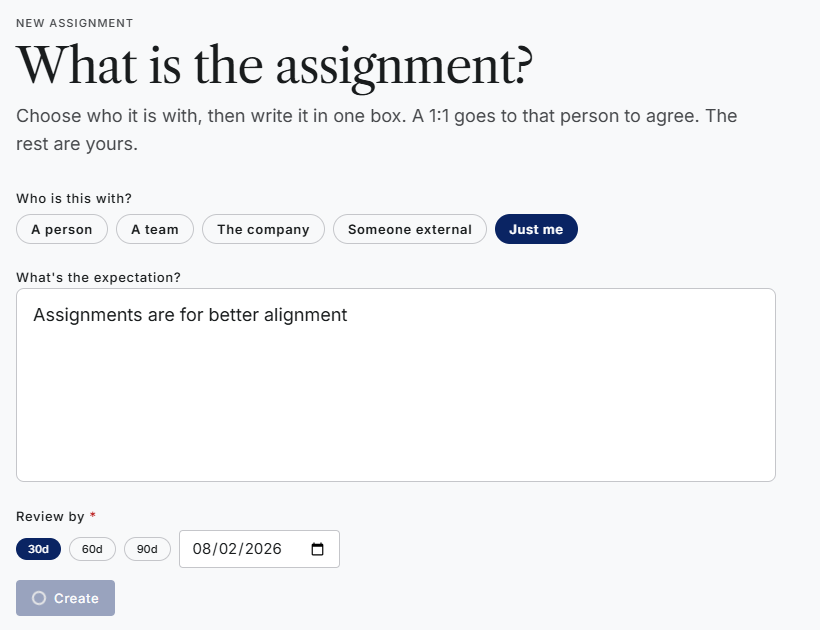
From a private note to yourself to a company-wide commitment, each assignment is scoped to exactly who it's with, so the right people see it and agree to it.
1:1
You and one personA direct agreement that goes to that person to co-sign. The clearest way to align on what one person owns.
Team
A lead and a teamOne expectation shared by a lead and their team, so everyone measures success against the same criteria.
Company
Across the companyOrg-wide commitments that keep every team pointed at the same objectives, visible to everyone they touch.
External
Clients and outsidersAgreements with clients and partners outside the company, with co-sign requests, renewals, and handoffs tracked.
Personal
Private to youPrivate notes and commitments to yourself. Yours alone, with the same review cadence keeping them honest.
A look inside
Every agreement, in one shared view.
Ask your agreements anything.
The built-in assistant reads across every assignment you can see. Ask it to summarize active contracts, flag what's up for renewal, or find where expectations have drifted, in plain language, right where the work lives.
- Summarize my active contracts
- What's up for renewal this month?
- Where are teams out of alignment?
Who it's for
For the people who have to answer for the team.
Managers & team leads
Set clear, written expectations once and stop relitigating them. Catch misalignment in week two, not at the quarterly review.
HR & people teams
Standardize how expectations are set across the org, so fairness and clarity don't depend on which manager you happen to report to.
Distributed teams
Replace the clarity you used to get from hallway conversations with explicit, shared agreements that work across time zones.
Questions
The honest answers.
A short, written, mutually agreed statement of what success looks like for a person or team in a given period: the objective, the criteria that prove it's met, and how often you'll check in. Both sides agree to it up front.
Managers and team leads who want fewer surprises, HR teams standardizing how expectations are set, and distributed teams where clarity can't rely on hallway conversations.
Review tools look backward, often once a quarter. BAS Accord sets the agreement at the start and keeps it visible, so the review becomes a formality both sides already expect, not an ambush.
BAS Accord is in active development. Join the waitlist and we'll let you know the moment early access opens, and we'll fold your input into what we build.
Have the agreement
before the review.
BAS Accord is launching soon. Join the waitlist if you have to answer for a team and you're tired of surprises.